Most contractors probably don’t think about their marketing in terms of “funnels.” We know it’s good to run ads, have a strong online presence & website, and give great service that makes repeat business. But how does this tie in to the idea of a marketing funnel?
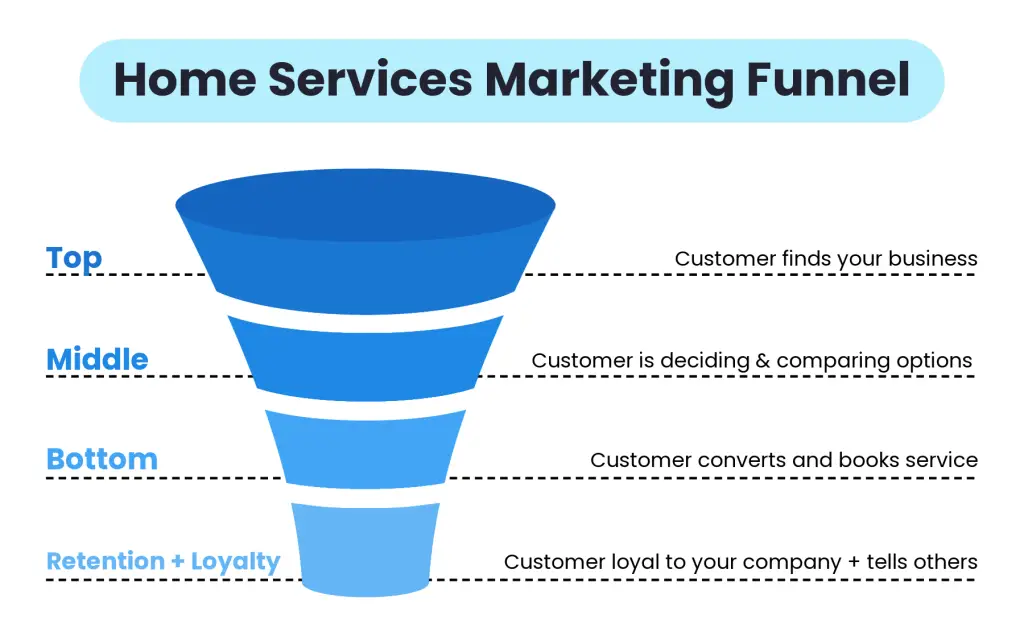
When we say funnel, we are just referring to the current stage a customer is in when shopping for their service need.
To put it simply, think of a funnel as the path a customer takes from: First hearing about your business → to choosing you → to booking a job → and hopefully coming back again as a repeat customer.
When that process is working well, things feel consistent. Jobs are coming in, your schedule stays full, and marketing feels like it’s doing its job. When it’s not, it can feel like you constantly need more leads just to keep up.
Let’s talk what this funnel actually looks like for home service businesses and where you can improve at each stage of the customer journey.
Why the Marketing Funnel Looks Different in Home Services
Often, the term marketing funnel (or sales funnel) is associated with e-commerce, retail, or big brands. But it applies just as much to service-based companies! In fact, the principles of a funnel can be applied to almost any business that involves the process of someone finding a business, then completing a purchase.
In home services, they just move a little differently than a traditional sales funnel for physical goods.
This is because customers are usually:
- hyper-local
- problem-driven
- often in a hurry
Most of your customers are not casually browsing for a plumber or HVAC tech. They’re looking because something needs to get fixed.
A typical journey might look like:
AC breaks → Google search → checks a few options → calls → books
It’s a shorter funnel than many industries, but each step still matters. And small gaps at any stage can lead to missed opportunities.
Top of Funnel Marketing for Contractors: Awareness and Local Visibility
The top of a funnel is the widest part of its structure. This is where potential customers first discover your business.
If someone searches for “AC repair near me” or “plumber in Phoenix,” your goal to pull in customers at the top of funnel stage, is to show up where they’re looking.
For home service businesses, this usually comes from:
- Google search (SEO and Google Ads)
- Google Business Profile (map pack)
- Social media ads targeting your service area
At this stage, you’re not trying to sell just yet. You’re just making sure your business is visible, relevant, and being seen by potential customers that are searching.
A few tips for strengthening this part of your funnel:
Google-
- Aim to rank for high-intent keywords like “AC repair near me” or “emergency plumber [city]”
- Use Google Ads to show up at the top of results when someone is actively searching
- Make sure your profile has accurate contact info, photos, service areas, and hours to help your business show up in Maps
Lead Platforms-
- Fully build out your profiles with services, photos, and descriptions
- Respond quickly to inquiries since many of these platforms prioritize speed
Social Media-
- Run Facebook or Instagram ads that highlight your team, recent jobs, or promotions
- Keep targeting tight to your service area so your budget is focused on the right audience
At this stage, the goal is simple. Be visible when someone needs you. If people can’t find your business when they need it, nothing else in the funnel matters.
Middle of Funnel: Building Trust and Standing Out From Other Contractors
Once someone finds your business, the next step is earning their trust. Now they’re in the middle of your funnel. Your goal is to get them all the way to the bottom to make a sale. What happens in this stage is critical to whether or not a customer will continue on to booking your company’s services.
In the middle of the funnel, homeowners start comparing options and deciding who feels most reliable. They’re looking at your reputation, your work, and how professional your business seems.
Basically, “Why should I choose you?”
Common deciding factors include:
- your reviews
- your photos
- your website
- how knowledgeable and trustworthy you seem
Often, decisions are made here, before a call, form fill, or inquiry even happens.
Here are a few tips to help you strengthen your customer retention during this stage of the funnel:
Website optimization
- Create clear, descriptive service pages for each offering like “HVAC Repair,” or “Hot Water Heater Installation”
- Make sure your site is easy to navigate and works well on mobile
- Include an FAQ page, or section on your site
Reviews and testimonials
- Highlight strong reviews on your website and Google Business Profile
- Respond professionally to your reviews to show that you’re engaged and care about customer experience
Photos and proof of work
- Share real before and after project photos
- Show your team, trucks, and real job sites to build credibility
Educational content
- Create simple blog posts or videos like “5 Signs Your Furnace Needs Repair”
- Answer common customer questions to position yourself as an expert Bottom of Funnel Marketing: How Contractors Convert Leads Into Booked Jobs
Bottom of Funnel Marketing: How Contractors Convert Leads Into Booked Jobs
Once your customer is at the bottom (and most narrow part) of your funnel, interest turns into action.
A homeowner has decided to reach out. Now the focus shifts to how easy you make it to move forward.
A few things matter a lot here:
- how quickly you respond
- how easy it is to book with you
- how clearly you communicate
In many cases, speed plays a bigger role than people expect. When someone has an urgent issue, they’re often contacting multiple companies at once, and the first one to respond usually has the advantage.
Here are some ways to improve your success at this stage:
Clear calls to action (CTA)
- Use buttons like “Book Now” or “Get a Free Estimate” on your website
- Make your phone number easy to find and click
Fast response time
- Answer calls as quickly as possible
- Use autoresponders to acknowledge messages right away, even after hours
Instant booking or online scheduling
- Allow customers to book directly through your website when possible
- Reduce friction so they don’t have to wait or call if they don’t want to
Follow-up and retargeting
- Follow up on missed calls and sent estimates
- Use retargeting ads to stay in front of visitors who didn’t book the first time
Even small improvements here can have a big impact on how many leads turn into real jobs. The bottom of the funnel is all about making it as easy as possible for your customer to convert.
Retention and Loyalty: Turning One-Time Customers Into Repeat Business
This is the part of the funnel that often gets overlooked, but it can have a big impact on long-term growth. A completed job is not always indicative of the end of the relationship with your customer. In many cases, it is the beginning of the next opportunity by either repeat business or word-of-mouth marketing to bring you new business.
Here’s how contractors can stay connected:
Email and SMS follow-up
- Send reminders for seasonal services like HVAC tune-ups
- Follow up after a job to check in and stay top of mind
Customer experience and service quality
- Deliver consistent, professional service every time
- Clear communication and reliability go a long way toward repeat business
Referral opportunities
- Encourage happy customers to recommend you to friends and neighbors
- Make it easy for them to share your information
Ongoing engagement
- Stay visible through occasional updates, promotions, or reminders
- Give customers a reason to come back when they need service again
Repeat customers are often easier to convert and are more valuable over time.
Key Factors That Impact Your Entire Marketing Funnel
No matter which stage of the funnel you zero in, a few key factors will always influence performance across the board.
Tracking ROI – It’s important to understand which marketing efforts are turning into booked jobs, not just leads. This helps you make better decisions about where to invest.
- Use tools like ServiceTitan or a CRM to track which leads turn into booked jobs
- Focus on revenue, not just lead volume
Speed to lead – Fast response times can make a noticeable difference, especially in urgent situations. Even a small delay can shift an opportunity elsewhere.
- In urgent situations, customers often go with the first company that responds
- Even a few minutes can make a difference
Segmentation – Not every customer is the same. New leads, repeat customers, and maintenance clients may all need different messaging and follow-up.
- Separate new leads from repeat customers or maintenance clients
- Tailor your messaging based on where someone is in the funnel
Simple Ways to Strengthen Your Marketing Funnel
This might feel daunting, but don’t worry. You don’t need to overhaul everything at once!
In many cases, the best approach is to:
- identify one or two weak points
- focus on improving those first
- build from there
For some businesses, that might mean improving visibility. For others, it could be tightening up follow-up or response times.
Small improvements across the customer journey can add up quickly. At VIIRL, we help home service businesses improve performance across the entire funnel. We get the challenges of pinpointing exactly which areas to improve, and which are performing well. If you need a boost to get started, grab a free marketing audit from an expert at VIIRL.
When each stage of your marketing funnel works together in harmony, growth becomes a lot more predictable and a lot less stressful.