Yelp is a great source for jobs, and plenty of plumbers, HVAC companies and roofers do well there. But when one platform controls most of your lead flow, every change it makes lands straight on your schedule. The fix is a mix of home service lead sources that keeps your trucks busy no matter which platform has a bad month.
Below, you’ll see how to spot the problem in your own numbers and fix it without raising your budget.
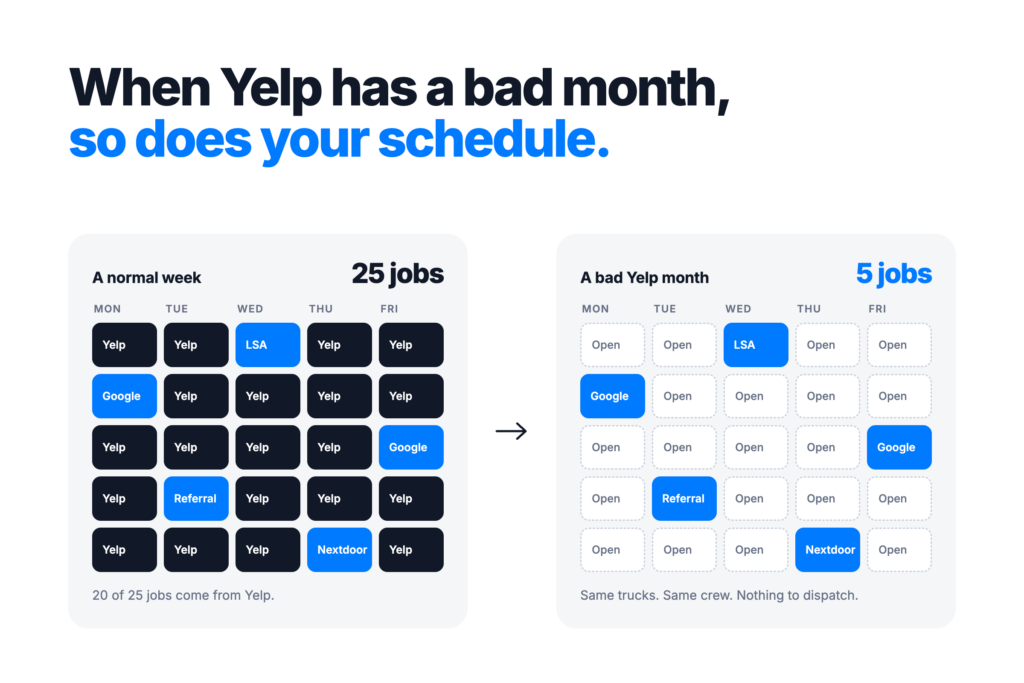
Why One Lead Source Is a Risk for Home Service Businesses
Platforms change the rules all the time, and you don’t get a vote.
Google is moving Local Services Ads out of their own dashboard and into Google Ads as a Performance Max campaign type, according to Google’s Local Services Ads transition guide. Manual bidding goes away, weekly budgets become daily, and old performance reports don’t carry over. A shop that gets most of its work from LSAs has to ride out that change with no backup.
Yelp changes too. In its Q2 2026 shareholder letter, Yelp said its AI-powered Yelp Assistant generated about 10% of Request-a-Quote projects in the quarter. That’s a real shift in how homeowners reach service pros on the platform.
When one source carries your business, a ranking drop, a policy update, a bad review streak or a competitor outbidding you can empty your board in a week.
Homeowners don’t search in one place anymore
The other reason to spread out: your customers already have. BrightLocal’s 2026 Local Consumer Review Survey found 71% of consumers use Google to read reviews of local businesses. The same survey found 45% now use AI tools like ChatGPT, up from 6% in 2025, and Apple Maps use jumped from 14% to 27%.
A homeowner might find you on Google, check your reviews on Yelp, ask ChatGPT who’s good in town and then see your name on Nextdoor. If you only show up in one of those places, you lose the rest.
How to Tell If You’re Too Dependent on One Platform
Pull the last 12 months of booked jobs and tag each one by where the lead came from: call tracking, form source or what the customer told your CSR.
Then look at the split. As a working rule, if one platform drives more than half of your booked jobs, you’re exposed. Picture what would happen to payroll if that number got cut in half for 60 days.
Also check cost per booked job, not just cost per lead. A $40 lead that books 20% of the time costs you $200 a job. A $90 lead that books 60% of the time costs $150. The cheapest leads aren’t always the cheapest jobs.
Building a Mix of Home Service Lead Sources
You don’t need to be everywhere. You need three or four sources that don’t all rise and fall together. Here’s a practical mix most home service companies can build:
- Google Business Profile and local SEO. Free to show up, and it feeds both Maps and your Local Services Ads. Keep hours, services, photos and reviews current.
- Google Local Services Ads. You pay per lead instead of per click, which makes them a good fit for urgent calls like burst pipes or no-AC days.
- Google Search ads. More control over keywords, service areas and budget, so you can push high-margin work like water heater replacements or full system installs.
- Yelp. A strong source in many markets, especially for homeowners who read a lot of reviews before they call.
- Angi, Thumbtack or Nextdoor. Worth testing in markets where homeowners use them. Start small and track booked jobs, not just leads.
- Your own customer list. Past customers, maintenance members and referrals cost the least and convert the best. Email and text them every season.
Don’t add everything at once. Add one channel, give it 60 to 90 days, measure cost per booked job and then decide whether to keep it or cut it.
Shift budget, don’t just add it
Most owners hear “diversify” and think “spend more.” You usually don’t have to. If Yelp is 80% of your budget, move 15% to 20% of it into a second channel and watch what happens. If that channel books jobs at a similar cost, keep shifting. If it doesn’t, you learned that cheaply.
The goal is a spread where no single platform could sink you, and where you know what every dollar in every channel is producing.
Make Every Channel Answer Fast
More lead sources means more places for leads to fall through the cracks. A Thumbtack message that sits for two hours is wasted money. So is a missed LSA call on a Saturday.
Before you add a channel, make sure your team can handle it. Route every source into one place, set alerts and use automated text replies so every lead hears back in minutes. Track every lead back to booked revenue so you know which channels are pulling their weight.
Spread Your Home Service Lead Sources Before You Need To
The best time to build your second and third lead source is while your first one is still working. Waiting until your Yelp calls dry up means building a new channel while payroll is due.
FAQ
What are the best lead sources for home service businesses?
Most home service companies do best with a mix: Google Business Profile, Google Local Services Ads, Google Search ads, Yelp, one marketplace like Angi or Thumbtack, and their own past customers. The right mix depends on your market, so track cost per booked job for each source.
Is it bad to get most of my leads from Yelp?
Yelp can be a strong lead source, but relying on any one platform for most of your jobs is risky. If one source drives more than half of your booked jobs, a ranking drop or policy change there can hit payroll fast.
How do I diversify my lead sources without spending more?
Shift 15% to 20% of your budget from your biggest channel into one new channel, run it for 60 to 90 days, and compare cost per booked job. Keep shifting if it performs, and cut it if it doesn’t.